
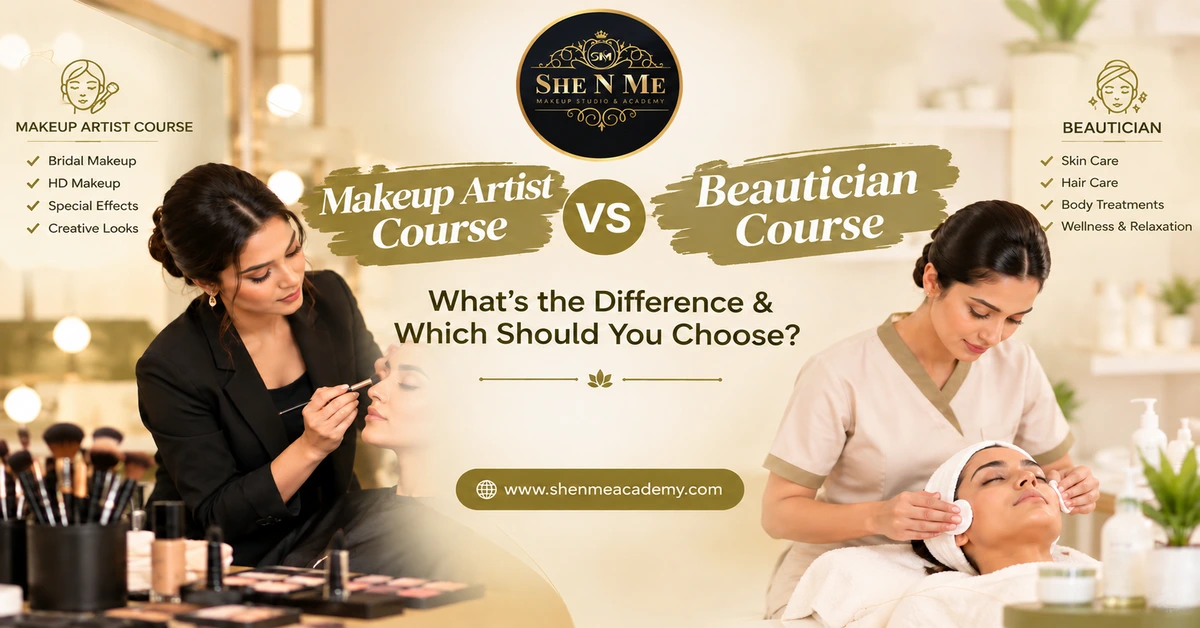
You search “beauty courses near me” and within two scrolls you’re staring at half a dozen options — Makeup Artist Course, Beautician Course, Beauty Parlour Course, Professional Makeup Course, Advanced Beauty Training. They all sound like they’re describing the same thing, just worded differently.
Aakhir difference kya hai?
That’s usually the actual question underneath all the searching: “Makeup Artist vs Beautician Course: what’s different?” (and it’s a fair one). Both paths lead into the beauty industry, but they don’t prepare you for exactly the same kind of work. One is generally built around a specific skill — makeup — and the depth that comes with focusing on it.
The other tends to spread wider, touching several beauty services instead of going deep into one. Neither is the “correct” choice in some universal sense. The right one depends on what you’re actually trying to build for yourself.
This article walks through that difference properly, so you’re not guessing your way into a course that doesn’t match what you want.
Makeup Artist Course vs Beautician Course in
Varanasi— What’s the Actual Difference?
Makeup Artist Course
A makeup artist course is built around professional makeup as its central skill — not as one topic among many, but as the thing the entire training revolves around. That usually means going deep into areas like bridal makeup, different makeup finishes for different occasions, client consultation, professional application techniques, and building enough practical experience that you’re comfortable working on people who aren’t you.
Because the focus stays narrow, the training tends to go further into detail than a general course would — how a base holds up under different lighting, how bridal makeup needs to be planned differently from party makeup, how to read what a client actually wants versus what they’re asking for. It’s specialization, essentially, and specialization usually means more depth in exchange for a narrower scope.
Beautician Course
A beautician course, generally speaking, is built to be broader. Depending on the academy and the specific course level, beautician training may cover a mix of beauty and salon services rather than concentrating on one skill. The idea is less about becoming an expert in one area and more about being capable across several — someone who can handle a range of beauty-service work rather than specializing deeply in any single one.
This broader approach suits a different kind of goal. If your interest is in beauty as a general field rather than makeup specifically, this route tends to give you more range to work with.
The distinction, in short: a makeup artist course trades breadth for depth in one skill, while a beautician course trades depth for breadth across several.
Comparison at a Glance
| Factor | Makeup Artist Course | Beautician Course |
| Main focus | Professional makeup, in depth | Broader beauty/salon services |
| Type of skills | Specialized — bridal, HD, event, editorial makeup | Varied — spans multiple beauty-service areas |
| Typical work | Makeup-specific client work | Broader salon/service-based work |
| Specialisation | High — narrow and deep | Lower — wide and general |
| Client opportunities | Bridal, event, freelance makeup clients | General beauty-service clients |
| Freelance potential | Strong, especially for makeup-specific bookings | Possible, depending on service range offered |
| Salon/business relevance | Useful when paired with business/salon-management learning | Directly relevant if working within a salon setup |
| Best suited for | Someone who wants to specialize in makeup | Someone who wants broader beauty-service skills |
What Do You Learn in a Makeup Artist Course in Varanasi?
Professional makeup training usually starts with the fundamentals — understanding skin, face structure, and how products behave differently from person to person — before moving into more specific areas like bridal makeup, where wear-time, photography, and long events all change how the work needs to be approached.
Client consultation tends to be a genuine part of the training too, not an afterthought. Learning to understand what a client wants, and translating that into an actual look, is a different skill from just knowing techniques. Beyond that, most courses build in real practical time — working on actual faces, repeatedly, rather than only demonstrations — because that’s where technique actually becomes instinct instead of memorized steps. Many courses also encourage students to build a portfolio of their work as they go, since that ends up mattering more than a certificate alone once you’re trying to attract clients independently.
The exact depth and modules vary by academy, so it’s worth asking directly what a specific course includes rather than assuming.
What Do You Learn in a Beautician Course in
Varanasi?
Beautician training, by design, tends to spread across a wider set of beauty and salon-service skills rather than narrowing in on one. Depending on the academy and the course level, this may include a mix of general beauty services, basic skincare-related knowledge, and other salon-relevant skills that go beyond makeup alone.
The value here is range. Someone completing beautician training is generally positioned to handle a variety of client needs rather than specializing heavily in one, which suits people who want to work across different services rather than commit deeply to just makeup. As with any course, the actual curriculum differs from one academy to another, so it’s worth checking specifics before enrolling.
Which Career Options Can You Explore After Each?
After makeup-specific training, the directions people commonly move toward include freelance makeup artistry, bridal makeup work, event and party makeup, and — for some — fashion, editorial, or content/production-related makeup work. Over time, many build toward independent client work and, eventually, something closer to a personal brand or business built around their name.
After beautician training, the directions tend to lean toward salon-based roles, broader beauty-service work, and eventually — for those who want it — running their own beauty parlour or salon setup.
Makeup Artist vs Beautician Course: there’s one thing in common; neither of these come with a guarantees. What a course gives you is a starting skill set; what you do with it after depends on practice, the work you take on, and how much you keep building past the training itself.
Which Course Gives You More Career Flexibility?
This is genuinely one of the most practical angles in the Makeup Artist vs Beautician Course decision, and the honest answer is: it depends on what “flexibility” means to you.
If flexibility means being able to work across many different beauty services, a beautician course generally supports that better, simply because it was built with that range in mind.
If flexibility means depth in one high-demand skill that can be combined with freelancing, bridal work, studio collaborations, or eventually a personal business — a makeup artist course tends to open that kind of flexibility instead. Professional makeup skills on their own already support several directions: independent client work, event collaborations, occasional studio or content-related work.
Where this gets more interesting is when a makeup course is paired with some understanding of running a business — pricing, client handling, basic salon operations. That combination widens what a makeup-trained student can eventually do, beyond just performing the skill itself. She N Me Academy’s Makeup Course, for instance, also includes salon management learning as part of its structure — which means someone training in makeup there isn’t only learning the craft, but also picking up some sense of how a beauty business actually runs, should they want to go that route later.
This isn’t a claim that no other course does this. It’s simply a feature of how this particular course is structured, and it’s worth knowing about if long-term flexibility matters to your decision.
What If You Want to Open Your Own Salon or Beauty Business?
Technical skill — whether it’s makeup or general beauty services — is only part of what running a salon actually requires. Handling clients well, pricing services sensibly, managing day-to-day operations, building some sense of branding, and eventually managing a small team are all things that sit outside the “how to apply makeup” or “how to do a facial” part of training.
This is exactly why some exposure to salon management can matter, regardless of which technical course you choose. If entrepreneurship is somewhere on your radar, even a few months down the line, it’s worth checking whether the course you’re considering offers any of this — or whether you’d need to pick it up separately later.
How Long Does Each Course Take?
Duration varies quite a bit depending on the academy, the course level, and how much the curriculum covers — there’s no single industry-standard timeline for either course type.
At She N Me Academy, the approved durations are:
- Makeup Course — 3 months
- Skin Therapy Course — 2 months
- Hair Course — 3 months
- Master Beauty Course — 8 months
- Nail Course — 1 month
- Salon Management Course — 1 month
If you’re comparing academies, it’s worth asking directly what’s covered in that time rather than judging purely by the number of months.
How Much Does a Makeup Artist Course Cost in Varanasi?
Fees genuinely vary — by duration, by how much practical/hands-on training is included, by whether the course goes into specializations like bridal or HD makeup, by certification, and by whether components like salon management are bundled in.
The one thing worth keeping in mind: a higher fee doesn’t automatically mean better training, and a lower one doesn’t automatically mean a shortcut. What actually matters is what you’re getting for that fee — how much practical exposure, how much guidance, whether there’s room to build a portfolio.
Are Short-Term or Capsule Beauty Courses Worth It?
Depends entirely on what you’re trying to get out of it. If you want to pick up one specific skill, test whether beauty as a field interests you, or add a specialized service to something you already know, a shorter capsule course can make sense — it’s a lower-commitment way to find out.
If you’re aiming for a genuine professional career, though, a short course usually isn’t enough on its own. Building real confidence in either makeup or broader beauty services tends to need more structured time and repeated practical exposure than a capsule format allows. Neither option is wrong — it’s about matching the format to what you’re actually trying to achieve.
Which Course Should You Choose?
Choose a Makeup Artist Course if:
You’re primarily drawn to professional makeup — bridal, event, or otherwise — and see yourself freelancing, building a portfolio, working independently with clients, or eventually building something of your own around that skill.
Consider a Beautician Course if:
You want broader exposure across beauty and salon services, and would rather build range across categories than specialize heavily in one.
Consider comprehensive training if:
You want to combine makeup with other beauty skills, or want some understanding of salon/business operations alongside the technical training — useful if you’re already thinking past just the skill itself, toward where it might eventually take you.
What Should You Check Before Paying for Any Beauty Course?
Before committing money to any course — makeup, beautician, or otherwise — it’s worth getting clear answers on a few things: what exactly is taught, how much of it is hands-on rather than theoretical, whether you’ll get to build a portfolio, whether certification is included, who’s actually teaching it, whether the course assumes prior experience or genuinely starts from the basics, what the duration is, what’s included in the fee, and — if entrepreneurship is part of your plan — whether any salon or business management is covered at all.
Academies that answer these clearly, rather than vaguely, are usually a better sign of what the actual training will look like.
Where She N Me Academy Fits In
For anyone weighing these options in Varanasi, She N Me Beauty Academy runs training across several directions rather than just one: the Makeup Course (3 months), Skin Therapy (2 months), Hair (3 months), Master Beauty Course (8 months), Nail Course (1 month), and Salon Management (1 month).
The detail worth knowing if you’re leaning toward makeup specifically — the Academy’s Makeup Course also includes salon-management learning as part of its structure. So alongside the technical makeup training, students pick up some grounding in how a beauty business actually operates, which matters if you’re thinking beyond just the skill itself toward where it could eventually lead.
Frequently Asked Questions (FAQs)
What is the difference between a Makeup Artist vs Beautician Course?
A makeup artist course specializes in professional makeup skills, while a beautician course generally covers a broader range of beauty and salon services.
Makeup Artist vs Beautician Course — which is better?
Neither is universally better — it depends on whether you want deep, specialized makeup skills or broader beauty-service training.
Which course is better for beginners?
Both are generally designed to accommodate beginners; the choice should be based on interest and goals rather than existing skill level.
Which course has more career opportunities?
A makeup artist course tends to open focused opportunities like bridal, freelance, and event makeup work, especially when paired with business/salon-management learning. A beautician course offers a broader range across different beauty-service roles.
Can I become a freelance makeup artist after completing a course?
Freelancing is a realistic direction after makeup-specific training, though building a client base and confidence usually takes continued practice beyond the course itself.
How much does a makeup artist course cost in Varanasi?
Fees vary by academy, duration, and what’s included — it’s best to check specifics rather than assume a fixed range.
How long does a Makeup Artist Course take?
At She N Me Academy, the Makeup Course runs for 3 months.
Can I open my own salon after completing a beauty course?
It’s a common long-term goal for people from both paths, though it usually requires some understanding of business/salon operations in addition to technical training.
There Isn’t a Universally “Right” Course
The honest answer, after all this, is that neither course is automatically the right one — it comes down to whether you want broad beauty-service skills, specialized professional makeup training, freelance and bridal opportunities specifically, or a foundation that could eventually support a beauty business of your own.
If that last part sounds like where you’re headed — makeup skills combined with some sense of how to run things beyond just the craft — a comprehensive makeup course with salon-management exposure tends to keep more doors open at once than a narrower option would.
If you’re still unsure which route actually fits you, it’s worth speaking directly with the Academy. This will help you with understanding how each course is structured before enrolling — that conversation usually clarifies more than another hour of searching would.